
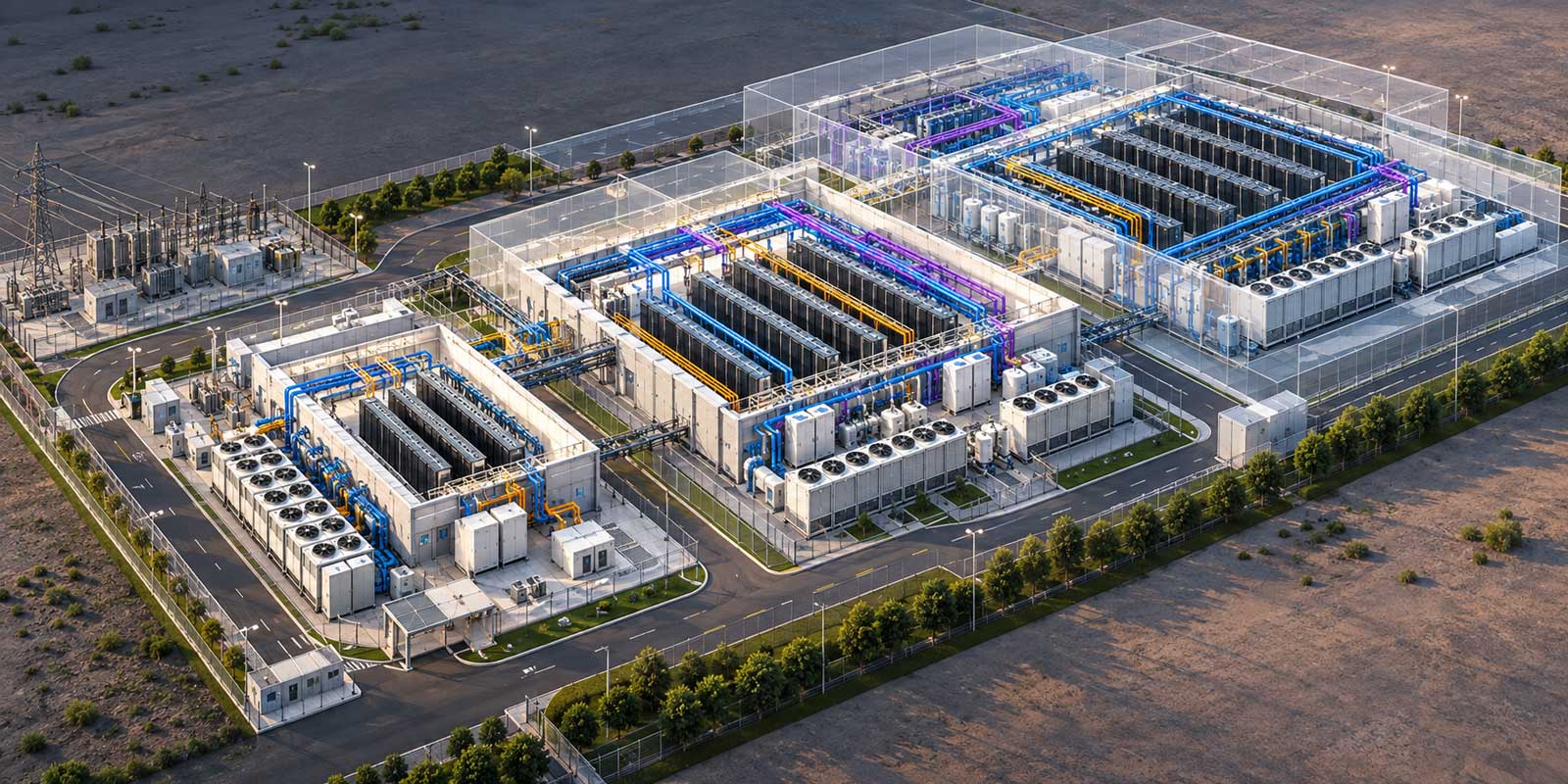
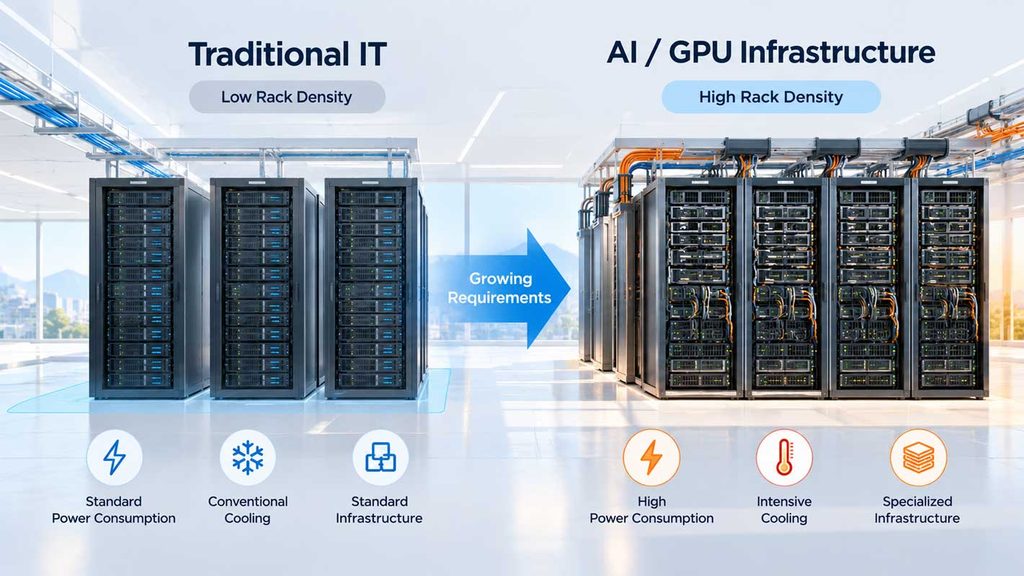
Not long ago, a 10–15 kW rack was considered a heavy load for most data centers. Today, a single fully configured NVIDIA GB300 NVL72 rack draws up to 142 kW and is designed for liquid cooling from the outset. A jump of more than an order of magnitude does not stop at the servers. It reshapes power supply, cooling, data hall architecture and even the sequence in which a facility is built. For Kazakhstan, the timing matters: new projects are now being measured in tens and hundreds of megawatts.
One Rack, a Different Data Center
The wider market still operates at a different scale. According to Uptime Institute, in 2025 most operators still reported typical rack densities below 10 kW, although adoption of 10–30 kW racks is gradually increasing.
Once a single rack needs more than 100 kW of power, an equivalent amount of heat removal, high-speed interconnects and safe access for maintenance, the whole facility has to be rethought, not just the cabinet.
Being AI-ready, therefore, is not about the ability to install GPUs today. It is about whether the engineering infrastructure can accept a different compute architecture tomorrow.
Why This Matters for Kazakhstan Now
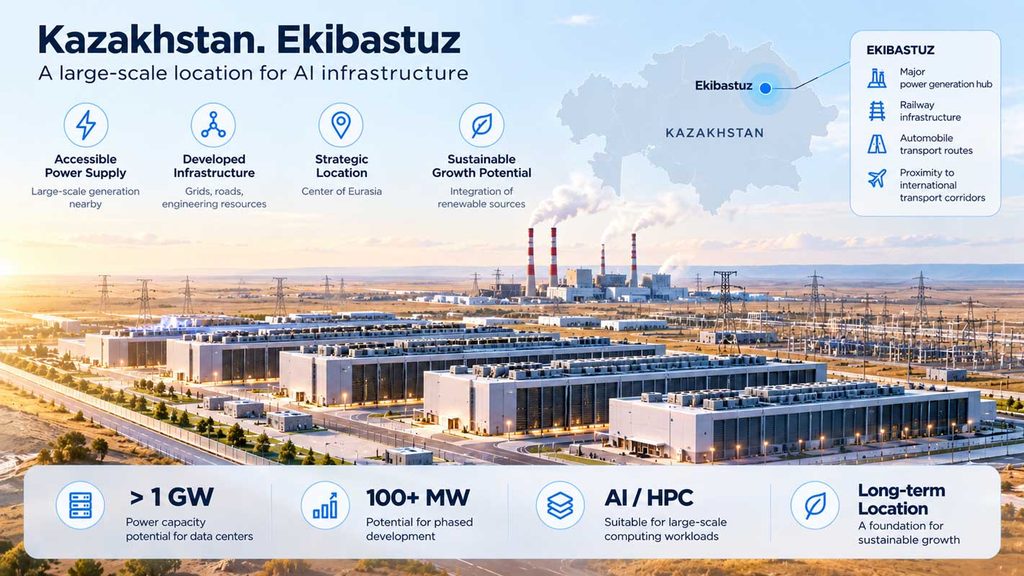
In Kazakhstan, this shift is no longer theoretical. In Ekibastuz, the Data Center Valley project is taking shape. In spring 2026, a 215 MW substation was acquired for the site, and its total potential has been announced at up to 1 GW. In August, the Ministry of Artificial Intelligence and Digital Development reported that Firebird, together with project operator Kazakhtelecom, is developing 125 MW of AI infrastructure there. The first capacity is scheduled to come online in 2027.
Other large projects are also under consideration. In May, the Ministry signed a memorandum with an international consortium to build a Tier III–Tier IV data center of 50 to 200 MW, backed by a dedicated gas-fired power plant of up to 250 MW.
Not all of the announced capacity has been built, and the projects are at different stages. But the direction of the market is clear: Kazakhstan is moving from relatively small, local server facilities to large-scale AI and HPC infrastructure. As scale grows, so does the cost of a wrong decision made early in a project.
Power and Cooling Are Part of the Architecture, Not Separate Disciplines
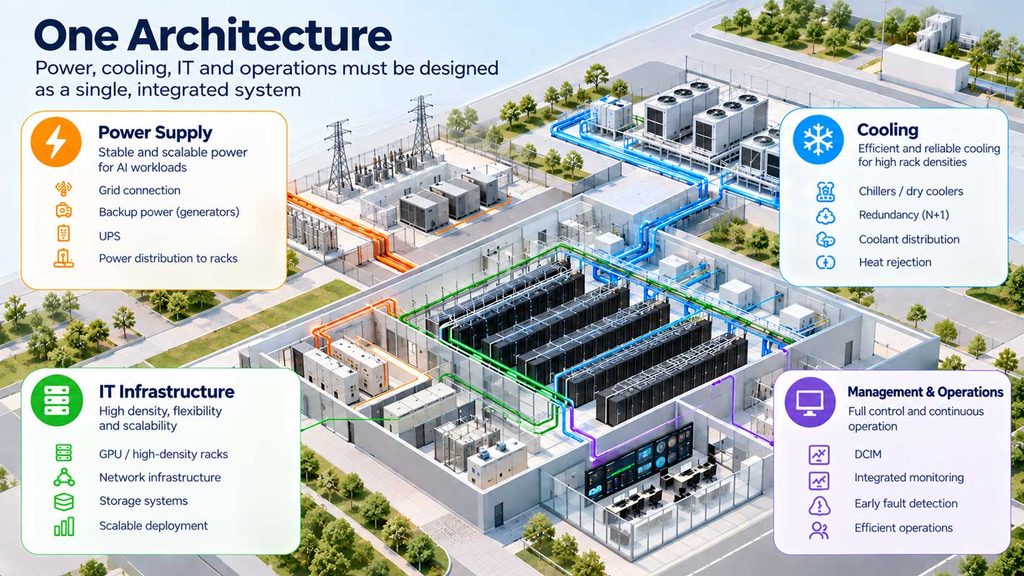
For a large data center, power is no longer just one engineering discipline among many. It determines the site itself. At tens or hundreds of megawatts, what matters is not only the capacity available today, but also the grid connection scheme, redundancy, the timeline for upstream network development and the ability to support a second and third phase.
AI makes this harder. According to the International Energy Agency (IEA), the power density of AI servers increased roughly elevenfold between 2020 and 2025. AI training and inference also cause large, rapid swings in power demand, which places additional requirements on the electrical system and makes energy storage critical.
Cooling is undergoing the same transformation. At high densities, air cooling is no longer a universal answer. Today’s rack-scale AI systems use direct liquid cooling (DLC), which brings coolant distribution units (CDUs), additional loops and manifolds, leak detection and new redundancy scenarios into the facility.
Yet the choice is not simply “air or liquid.” The real test is whether the infrastructure built today can accommodate a different density and a different heat rejection method a few years from now.
That is why at TSG we treat power, cooling, IT load placement and operations as parts of a single architecture. A decision in one of these areas increasingly constrains the options in all the others.
Design for Change, Not for Today’s Load
A data center takes years to build and is operated for decades, while compute hardware generations turn over much faster. Predicting server specifications ten years out is not realistic. What owners can do is define, in advance, the boundaries within which the facility will be able to evolve:
- available and reserve power capacity;
- density of individual zones;
- power distribution;
- pathways for future liquid cooling;
- data halls and support spaces;
- the ability to add phases without rebuilding live infrastructure.
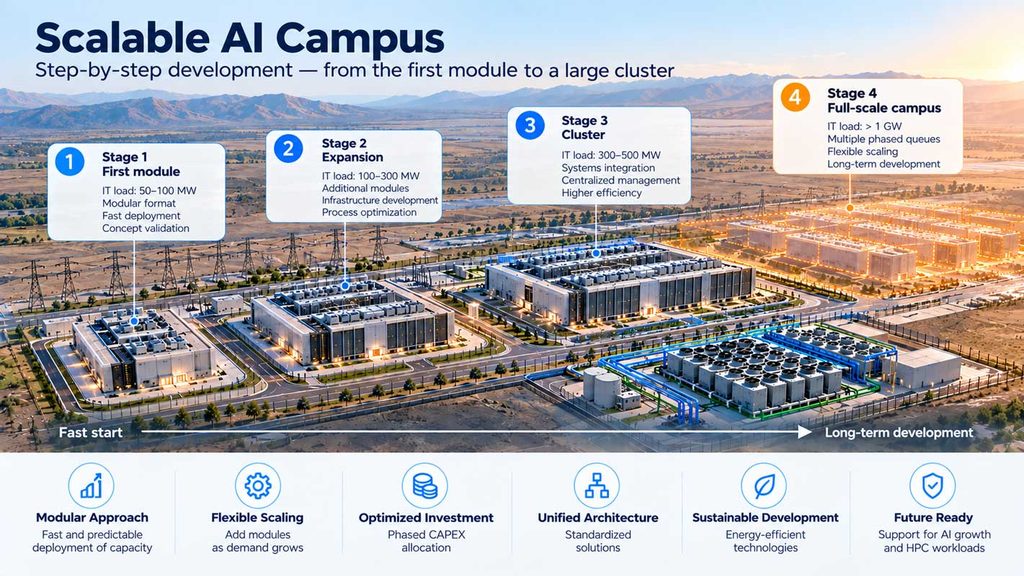
This gives modularity a new meaning. It does not necessarily mean a containerized data center. It means an architecture in which power, cooling and white space are delivered in controlled phases. The first phase is built for a known load. The next can adopt a different density, a different cooling technology and a new generation of compute platform.
Modularity buys more than construction speed. It buys time for the next engineering decision.
For large projects in Kazakhstan, this is particularly important. Building the full end-state infrastructure up front, based on technology assumptions ten years ahead, means locking in significant CAPEX while making decisions under high uncertainty.
AI Readiness Is Proven After Construction
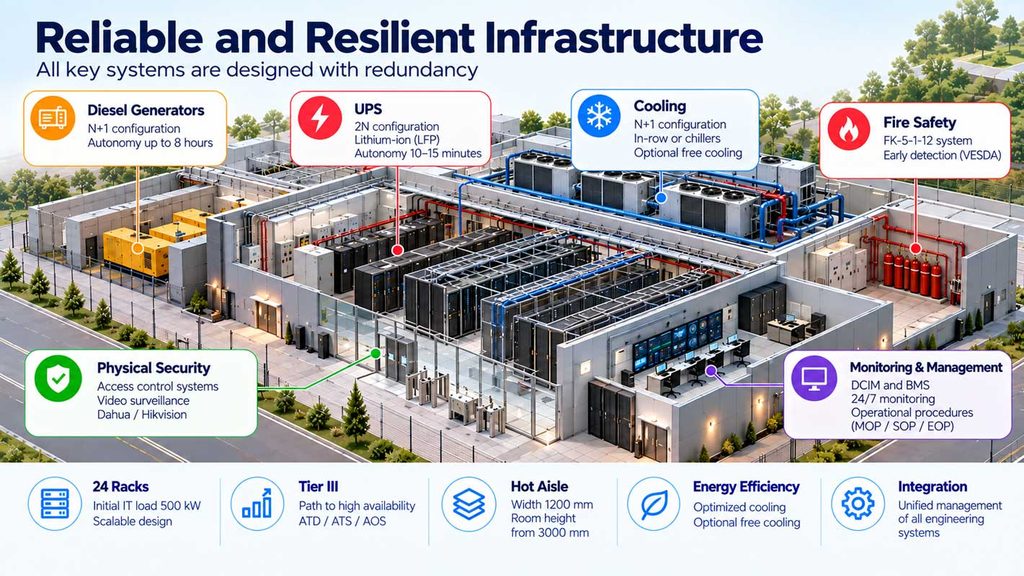
One area is easy to underestimate while a project still exists only on drawings: operations. High-density, liquid-cooled infrastructure adds new loops, CDUs, leak detection systems and a much tighter coupling between IT and facilities. Maintenance and emergency procedures (MOPs, SOPs and EOPs) change, as do critical spares strategies and staff competency requirements.
Commissioning such a facility therefore cannot be reduced to testing equipment in isolation. The UPS may perform as designed. So may the cooling plant and the CDUs. The decisive question is what happens to the IT load when several systems must respond to a failure at the same time. Only Integrated Systems Testing (IST) can answer that, and it needs to be planned, together with the operating model, at the design stage.
A data center is built once. It is operated every day.
Five Questions to Answer Before Designing an AI Data Center
Before selecting a UPS vendor, chillers or a server platform, owners are better served by answering more fundamental questions:
- What compute load must the facility support today, and what might it need to support tomorrow?
- What density is achievable not as a facility average, but at the level of individual racks and zones?
- How will the cooling system evolve as the facility moves to high density and liquid cooling?
- How will future phases be added without rebuilding a live facility?
- How will the data center be tested, maintained and operated after handover?
The answers to these questions shape the project’s architecture. Equipment comes later: it can be replaced, whereas the architecture of a completed facility is far harder to change.
The Advantage of a Young Market
Kazakhstan has a rare advantage: much of its large-scale data center infrastructure is still being formed. Mature markets face costly retrofits to adapt existing facilities for AI. In Kazakhstan, new sites can be designed from day one for high density, liquid cooling, phased expansion and long-term operations.
But this advantage can be used only once, at the design stage. The key question for a new AI data center is therefore not “How many megawatts do we need today?” but “What changes must this facility be able to absorb over the next 10–15 years?”
If the answer comes before construction, a change in technology becomes a manageable engineering task. If it comes after, it becomes a constraint of a facility already built.
About TSG
TSG is a systems integrator and general contractor serving the energy and industrial sectors in Kazakhstan. We design, build and commission data centers, including modular solutions, and take responsibility for results from concept through integrated systems testing.
Let’s work through the five questions for your project. In a working session with TSG engineers, we will review your site, target load and growth scenarios, and identify the decisions that need to be locked in before design begins.
Sources
NVIDIA — NVL72 AI Factory: System Hardware & Components
NVIDIA GB300 NVL72 architecture: liquid cooling, leak detection, full-rack power of up to 142 kW.
https://docs.nvidia.com/enterprise-reference-architectures/nvl72-ai-factory/latest/components.html
Uptime Institute — Global Data Center Survey 2025
Rack densities: most operators report typical densities below 10 kW; adoption of 10–30 kW racks is growing.
https://intelligence.uptimeinstitute.com/resource/uptime-institute-global-data-center-survey-2025
Government of the Republic of Kazakhstan — Data Center Valley, Ekibastuz (in Russian)
Acquisition of a 215 MW substation and total site potential of up to 1 GW (April 2026).
https://primeminister.kz/ru/news/olzas-bektenov-provel-soveshhanie-po-realizacii-proekta-dolina-codov-v-ramkax-ispolneniia-porucenii-prezidenta-31285
Ministry of Artificial Intelligence and Digital Development of Kazakhstan — Firebird and Kazakhtelecom (in Russian)
125 MW of Firebird AI infrastructure in Ekibastuz (August 2026, reported by Kazinform citing the Ministry).
https://www.inform.kz/ru/kazahstan-voshel-vmezhdunarodnuyu-set-ai-infrastrukturi-firebird-fa715126
Ministry of Artificial Intelligence and Digital Development of Kazakhstan — Memorandum on a data center of up to 200 MW (in Russian)
Tier III–Tier IV data center of 50–200 MW with a gas-fired power plant of up to 250 MW (May 2026, reported by Kapital.kz citing the Ministry).
https://kapital.kz/tehnology/147740/data-centr-za-dollar3-mlrd-namereny-postroit-v-kazahstane.html
International Energy Agency — Key Questions on Energy and AI, 2026
Elevenfold increase in AI server power density between 2020 and 2025, and the impact of AI loads on power systems.
https://www.iea.org/reports/key-questions-on-energy-and-ai/executive-summary